For Home Assistant
Your home, mapped and in sync.
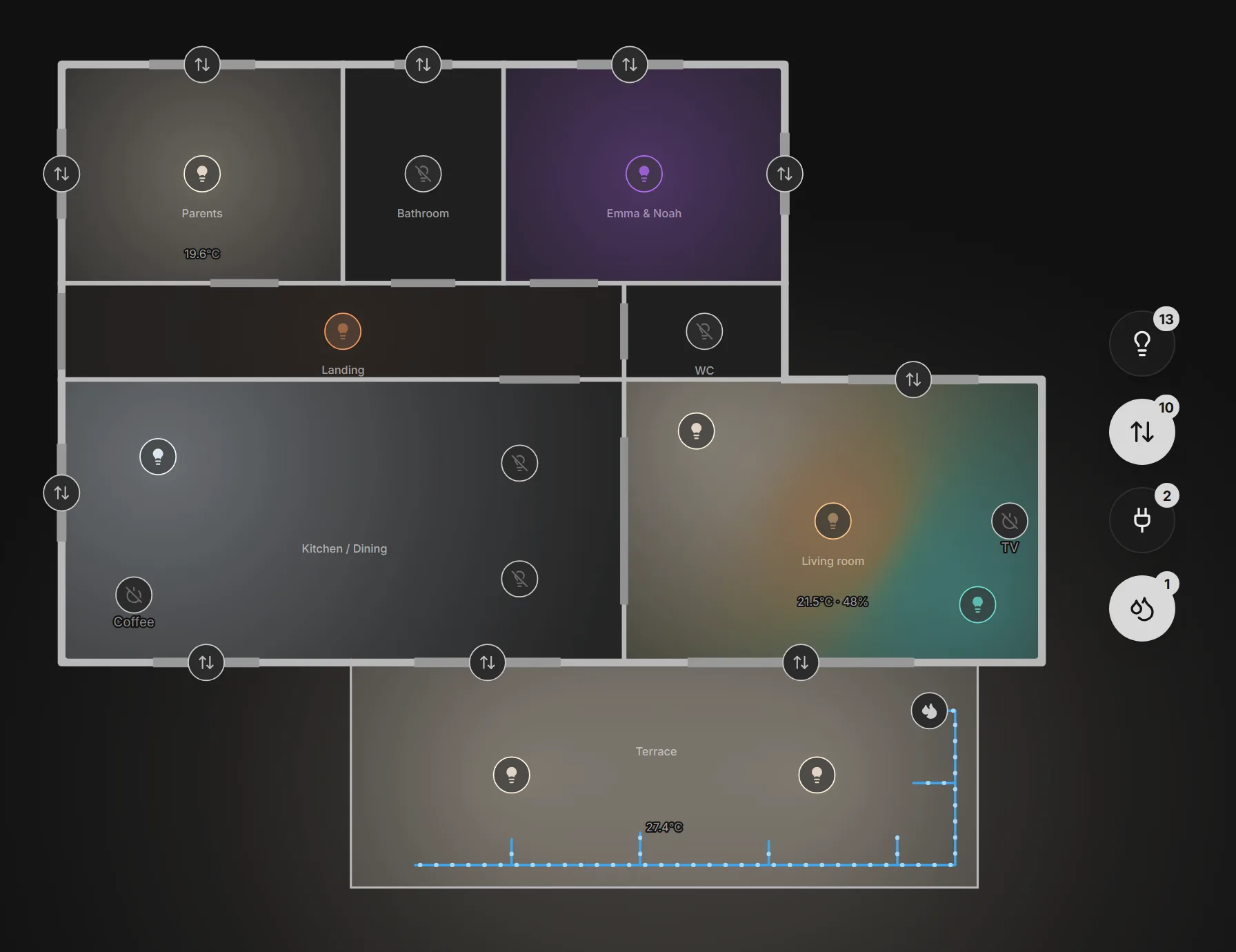
Your smart home on a floor plan. Visualize and control your connected devices via Home Assistant - private, secure, no cloud middleman.
Runs as a Home Assistant add-on, so it needs Home Assistant OS or Supervised (Container or Core?). Made for tablets and desktops.
How it works
From plan to control, in three steps
No tricky network setup. You draw, you link, you control.
Step 1
Draw your plan
Trace your walls, add rooms and floors in a simple 2D editor.
Step 2
Link your devices
Install the add-on in Home Assistant and pair it with a code. Then pin lights, outlets and shutters on the plan and map them to your entities.
Step 3
Control live
Switch on, dim, open your shutters. Real state flows back in real time from your home.
Private by design
Your home stays yours
Stratorama never connects directly to Home Assistant and never hosts your devices. Everything flows through a secure relay over an outbound connection from your add-on.
No ports to open.The add-on makes an outbound connection, so nothing is exposed to the Internet.
No cloud middleman.Your device data is not stored on our servers.
You stay in control.Disconnect the add-on whenever you want, in one click.
Pricing
Free for you. Forever.
You only pay when you want the rest of the household in.
Free
€0forever
Everything you need to map your home and run it yourself, from anywhere.
- The full editor: rooms, walls, doors, windows, floors.
- Every device type: lights, LED strips, shutters, outlets, valves, sensors.
- Remote access through the relay, included. No port to open.
- No card, no trial, no expiry. We will never move a free capability behind Household.
Household
€3/ month, or €30 a year
One price for the whole home, not one per person.
- Everything in Free.
- Share your home with the people you live with, each with their own sign-in.
- Give each member only the floors and devices you choose.
- A dedicated credential for wall tablets, separate from your own account.
- Two months free on the yearly plan.
You create your account first, then we take you straight to payment.
Prices include VAT. Cancel online at any time, effective at the end of the period you paid for, and 14 days to change your mind with a full refund. The first 100 homes to subscribe keep their price for as long as their subscription runs, even once it goes up for new subscribers. Read the terms.
FAQ
Before you install anything
The questions worth asking before you sign up.
Which devices can I put on the plan?
Lights and LED strips (Home Assistant's light domain), roller shutters (cover), power outlets and electro-valves (switch), and read-only sensors (sensor: temperature, humidity, CO2, power and so on). Anything Home Assistant exposes in one of those domains, whichever integration is behind it.
Do I need Nabu Casa or any remote-access setup?
No. The Stratorama add-on opens one outbound connection to our relay, and your browser talks to the relay. No Nabu Casa subscription, no port forwarding, no dynamic DNS, no reverse proxy - and nothing about your Home Assistant becomes reachable from the Internet.
Does it work with Home Assistant Container or Core?
Not yet. Stratorama connects through an add-on, and add-ons need the Supervisor, which only Home Assistant OS and Home Assistant Supervised have. A standalone agent for Container and Core installs is not built yet; we know it is a gap.
Where is my data stored?
On our own servers at OVH in Gravelines, France, inside the EU: your account, your plans and the bindings between your elements and your Home Assistant entities. Encrypted backups go to Scaleway in Paris. Transactional emails go through Resend (United States) and, if you subscribe, payments through Stripe. The privacy policy lists every processor and how long each thing is kept.
What does Stratorama see of my home?
The entity ids you bind to the plan, and their state changes while they cross our relay - in memory only, never written to disk, and forwarded only to the browsers allowed to see that device. Ordinary actions, a light or a shutter, are not recorded. Switching a device we class as consequential (today: electro-valves, because water starts running) leaves an entry saying who, which device and when, readable by the home's owner only. We never see your Home Assistant credentials: the add-on keeps its local token to itself.
How do I disconnect?
In Stratorama, Settings > Home Assistant > Connection > Disconnect add-on revokes the add-on's credential at once; the connection drops within a second. Uninstall the add-on to remove the last trace from Home Assistant. Deleting your account cuts the link immediately too, and removes your home and plans after a 30-day grace period (a shared home passes to another member instead).
Can I use it on my phone?
Stratorama is made for tablets and desktops, and a wall-mounted tablet is its natural home. On a phone you can sign in and control your home in presentation mode, but drawing needs the room a larger screen gives: the editor has no phone layout yet.

Give your connected home a map.
Free. Build your plan in minutes.
Built and run by one independent maker in France. The Home Assistant add-on is open source under the MIT licence: read it on GitHub.